Fundamentals
The Complete Copywriting Process
A complete copywriting process takes a project from an agreed brief through research and drafting to an approved page and measurement. Leave something reviewable at each stage, with owners for facts and decisions. Choose the message from evidence, resolve uncertainty before publication, and check the actual experience through the next action.
By the end of this lesson
Build a writing packet with evidence, review owners and launch checks.
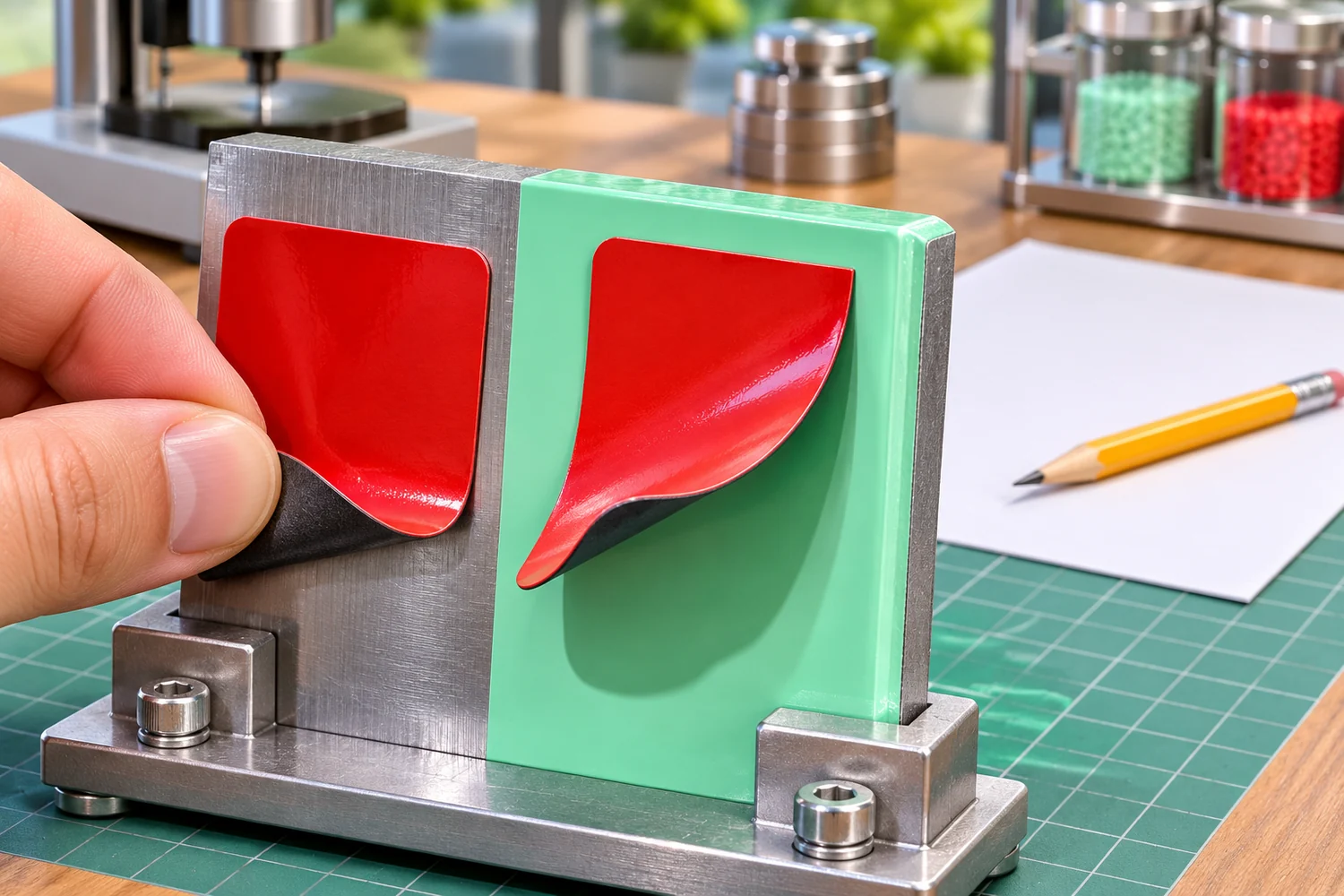
At the review table at Gloamberry Labels, Esben watches a red sample label slide down the shelf. His manager wants the product page approved before lunch. Gloamberry, Esben and this review are invented, and so is the draft's claim that the reusable stockroom labels "work everywhere."
Esben puts a hand under the sample to catch it. He can't approve a page that says "everywhere" while the label won't stay on this shelf, so he highlights the claim for the product owner.
Agree on the decision and the owner
Before anyone repairs the headline, ask what the page has to help a buyer decide. Gloamberry's buyer is a stockroom manager who wants to move labels when the shelf layout changes. They need to know whether these labels suit their own shelves before they choose a pack.
Esben writes that purchase decision at the top of the brief. If the labels won't hold on the buyer's shelves, a more appealing description won't make them suitable.
Ask one person to settle product facts and one person to give final approval. They can be the same person on a small team. Write their names beside the compatibility question in the brief.
The decision on the writer's desk
Decision and reader
- Reader: a stockroom manager rearranging shelves.
- Decision: can these labels move between the shelves they use?
- Action: check suitability, then choose a pack.
Who can settle the loose label?
- Product owner: show which shelf surfaces have been checked.
- Writer: revise the opening around the supported use.
- Approver: review the page with the compatibility limit visible.
Collect evidence before collecting headlines
For this exercise, assume the product owner's demonstration confirms that the labels hold when moved between the uncoated steel stockroom shelves shown. The meeting-room shelf has a different coating, which the record doesn't cover. Esben saves the surface description beside the demonstration photograph.
In your own record, name the surface shown in the photograph and who confirmed it. Include the demonstration date so a later reviewer can ask whether the product or its instructions have changed.
Copyhackers treats research and writing as separate stages, followed by validation. Use the copywriting research lesson to plan the investigation before you choose a headline.
Choose the message and its support
Esben now has evidence for a narrower lead: moving labels between those steel shelves. Before drafting it, he asks whether the intended buyers actually use that surface. A feature you can prove still has to matter to the person in your brief.
If buyers use a different coating, ask for a demonstration on that surface. Put that request with the buyer question that prompted it, so the product owner knows which use needs checking.
The product owner agrees to name the checked finish on the page. Esben writes the message decision in the brief: lead with moving the labels, and show the checked surface in the opening photograph.
In the research-to-copy lesson, this selection becomes a message map: a short record of the claim and the evidence supporting it. Keep the abandoned universal claim out of the headline options.
Outline the page around questions
Lay out the page around the manager's purchase decision, with the surface description next to the product demonstration. Put pack contents near the pack selector, where someone choosing a quantity will need them.
The designer asks whether the compatibility line can go in a small footer. Review the opening and photograph at their intended size: can a buyer see which shelf finish is covered? If they need the footer to discover that limit, move it closer.
You can discuss page length once those questions have a place. Give the designer an outline with the surface information next to the photograph. That lets you review its position before polishing the page.
Draft freely, with uncertainty visible
Now write the rough page. Keep a working comment alongside anything you still need confirmed, such as the pack contents. Make those comments easy to distinguish from customer-facing text so they can't quietly survive into publication.
Esben drafts the headline: "Peel a label off one steel shelf and stick it on the next." Beneath it: "Tested on uncoated steel shelving. Other finishes haven't been confirmed."
His first body paragraph uses only the demonstration: "Lift the red label by its corner and press it onto the next shelf. It holds there the same way." A working note sits under it in brackets: confirm the pack contents before approval.
The photograph gives a buyer a surface to compare with their own. Read the opening alongside it before sending the draft for approval.
If you want to explore headline options, keep the same factual boundary across the alternatives. Otherwise the shortest option may win because it quietly drops the condition. Judge each headline together with the surface line under it, since a buyer will read them together.
If you use AI to explore wording, provide the checked surface description with the rejected universal claim. Ask for alternatives within that limit, then review each against the product record.
Review in passes, with different questions
Esben's manager points to the surface line: "Can we lose this? It makes the labels sound fussy." Esben puts the loose red label next to the draft's "works everywhere" claim.
"Which version should I send to someone with this shelf?" Esben asks. His manager approves the headline and keeps the surface line, asking him to make it easier to read.
Esben can now adjust the wording and layout while keeping the agreed surface description intact. He puts the revised opening beside the demonstration for the manager's final page review.
The FTC's substantiation policy calls for a reasonable basis for objective US advertising claims before they run. For this project, the practical question is whether the product owner can support the surface claim you plan to publish.
Settle that question before smoothing the prose. Use a separate pass for awkward wording and repetition; the editing lesson offers a fuller sequence.
For the accuracy pass, the editor compares the headline with the demonstration record. For the wording pass, they read the surface line at the size a buyer will see. A cramped line needs a layout change even when every word is accurate.
What each reviewer needs to answer
Approve the argument
Would this opening help the stockroom manager judge suitability?
Resolve factual questions
Which surface does the evidence actually cover?
Edit the words
Can the reader find that limit without hunting?
Approve the actual page
Does the selected pack keep its name through checkout?
Validate the message with unfamiliar readers
Put the draft in front of someone who hasn't sat through the shelf discussion. Ask them to choose the information they'd need before ordering labels for their own stockroom. Listen when they explain where they think the labels will work.
If the reader expects the labels to work on every finish, review the photograph with its neighboring text. Record which part of the page led them to that expectation before changing the layout.
Keep the reader's account alongside the screen they saw, then show the revision to another unfamiliar reader. Ask them to point to the surface description and explain whether their own shelves match it. This checks their reading of the page; purchases need separate measurement.
Follow the page through checkout
In the built page, Esben's manager selects a starter pack. Checkout calls it a refill pack, so Esben pauses approval and asks the product owner to compare the contents.
The product owner confirms that both records describe the same contents and approves "Starter pack" for the selector and checkout. Esben corrects checkout, then selects the pack in the narrow layout and follows it to the cart. He captures the matching names for the approver.
W3C's writing guidance recommends meaningful headings and link text, along with clear instructions and text alternatives for images. Use the launch review to read those small pieces too.
On the product page, check whether the surface line stays beside the photograph when the columns stack.




A name mismatch can expose a product question as well as a copy error.
Keep the checkout correction in the approval file
The approval capture shows Starter pack in the selector and cart. Keep the product owner's confirmation beside it so the next reviewer can see why the name changed.
What should you measure after the page ships?
Before publication, choose a question you'll be able to investigate afterwards. For Gloamberry, ask whether buyers still expect the labels to hold on unconfirmed finishes.
For this exercise, track orders placed in the first two weeks after launch and follow those buyers' compatibility questions through the end of week three. Record total orders and count each questioning buyer once, keeping their shelf finish and exact question.
A rise in orders after launch wouldn't, by itself, tell you the revised copy caused it. Traffic or the offer could have changed too. The A/B testing lesson explains how a controlled comparison can help when an appropriate test is possible.
The complete checklist can support your final review. At the end of the third week, inspect every case where a buyer expected support for an unconfirmed finish.
Ask those buyers which words or image led them to expect compatibility. If they point to a misleading passage, revise it and repeat the unfamiliar-reader check; otherwise, investigate the product or support issue before changing copy.
Build a packet another writer can use
Try a handoff on one page you're responsible for: ask another writer to propose a headline from your packet without a verbal briefing. The broader Fundamentals sequence can help with the wording.
If their headline broadens the claim, ask which part of the packet allowed that reading. Amend that instruction before they reuse the copy on another page.
Before leaving the review table, Esben turns the loose red label over. On its sample card he writes, "Will it hold on the meeting-room shelf coating?" He clips the card to the product owner's demonstration request.
Read next

Lesson 8 of 8 in Fundamentals
Explore learning paths after The Complete Copywriting ProcessSources & further reading
- The 3-part conversion copywriting process for newbies
- FTC Policy Statement Regarding Advertising Substantiation
- Writing for Web Accessibility