Frameworks
Copywriting Formulas: AIDA, PAS, BAB, 4Ps and More
Copywriting formulas give a draft an order, from earning attention to explaining how a feature helps. Choose a structure according to what the reader needs to understand next, using supported offer facts. Keep necessary evidence and conditions in the argument, and revise any wording that sounds like an acronym being filled in.
By the end of this lesson
Choose and adapt a copywriting formula to a reader's decision without inventing pain, proof or urgency.

In his kitchen, Auden presses a knife into a tomato and watches it collapse against the board. We'll use this invented cook and Bramblebolt, a fictional mail-in sharpening service, to try five ways of explaining the same offer.
Auden wants to keep using this knife. Before he sends it away, he needs to know whether Bramblebolt accepts it and what sharpening could change. Your choice of formula determines where you begin answering those questions.
For the worked drafts, suppose the service has filmed a comparison: one accepted blade crushes a tomato before sharpening and cuts slices afterward. Give every draft the same limit: it can describe what happened to that blade.
How do you choose a copywriting formula?
A formula gives the argument an order. If Auden is unsure about sending knives away, begin with the accepted knife types and the mailer. A returning customer who already knows that process may only need current ordering information.
Use customer awareness to decide where that explanation begins. Then sketch an order and see which unanswered questions remain.
Treat the matches below as editorial starting points within Frameworks. The sources cited for these names document how writers use them; none establishes who first wrote AIDA, PAS, BAB or FAB.
Match the structure to the missing explanation
What the reader needs
- A reason to consider an unfamiliar offer
- Recognition of an existing problem
- A concrete picture of a change
- Confidence in a substantial promise
- The meaning of a product detail
A starting structure
- AIDA: develop an argument toward action
- PAS: connect a problem to its remedy
- BAB: connect the current and desired situations
- Four Ps: make room for proof
- FAB: explain how a feature helps
Bramblebolt supplies a protective mailer with separate sleeves and sharpens accepted knives before returning them. The offer record lists prices before checkout, with no specified delivery schedule or established transit-protection guarantee. Keep it beside the draft as you compare structures.
What can we verify about their origins?
William Walker Atkinson's 1912 The Psychology of Salesmanship describes ten purchase stages in chapter VII, from involuntary attention to action. Treat that longer sequence as historical context.
AIDA: build a reason to keep reading
AIDA stands for attention, interest, desire and action. Copywriting Course's formula reference describes the sequence. You can cover those jobs in a short email without giving every stage its own paragraph or public heading.
For someone new to Bramblebolt, try this practice draft:
The knife presses down and the tomato collapses before you get a slice.
Bramblebolt sharpens accepted kitchen knives by mail. Order a protective mailer, pack using the included instructions and send your knife to Bramblebolt for sharpening and return.
Watch our comparison: the same blade that crushed a tomato cuts slices after sharpening. The blade type and sharpening work are identified. Check whether we accept your knife and review the current price before deciding whether to send yours.
See how mailing works.
Adjust AIDA for a returning customer
- Skip the familiar kitchen scene.
- Show current acceptance and price details.
- Keep the comparison available for another look.
- Offer a mailer order under the current terms.
The desire stage connects the demonstration to Auden's wish to keep using his knife. He can inspect the change in the demonstrated blade before considering the mailing commitment. Keep acceptance details near the action so he can check whether his own knife qualifies.
For this first-time visitor, I'd keep the mailing explanation before the action. Ask someone unfamiliar with the service to find out how they would send a knife; use any confusion to revise that part of the draft.
PAS: give the problem an accurate size
PAS is problem, agitation and solution. The middle stage develops what the problem costs someone in the task. Keep the size of that inconvenience grounded in customer evidence; the letters don't tell you how distressed a reader feels.
For PAS, try this version of Auden's kitchen scene:
You've put the knife aside halfway through preparing the tomato.
The blade still hasn't cut through the skin. There's juice across the board, and the remaining slices are waiting.
Bramblebolt sharpens accepted kitchen knives by mail. Check which knife types we take before ordering a mailer.

Copyhackers documents PAS as a practitioner structure. To edit the middle stage, underline each consequence you've added beyond the original problem. In this draft, juice on the board belongs to the kitchen scene; a ruined dinner would need an account that actually describes one.
Auden can recognize the crushed tomato without being told he's a bad cook. If your research identifies a larger consequence, you can examine whether it belongs in the draft. Here, the mess on the board gives the solution enough context.
BAB: make the bridge carry weight
BAB stands for before, after and bridge. For this draft, the bridge is the mailing process. Give it enough room that someone can judge what they're being asked to do.
A working version could read:
Before: Our filmed comparison begins with an accepted kitchen knife crushing a tomato.
After: The same blade cuts tomato slices after sharpening.
Bridge: Check that we accept your knife type. Order the protective mailer, pack using the instructions and send it to Bramblebolt for sharpening and return.
A BAB bridge the reader can inspect
An unsupported transformation
From kitchen chaos to effortless cooking. Just join Bramblebolt.
A change with a mechanism
Send your accepted kitchen knives in our protective mailer. We sharpen them and ship them back for your next round of cooking.
Ask the operator to check the acceptance wording and return process in this candidate.
The bridge lets Auden judge the commitment: he has to check acceptance and pack a blade for mailing. Put any shipping charges and preparation requirements where he can inspect them before ordering.
Use messaging hierarchy to give the conditions room. You can keep the main line short and develop the process nearby. Read the whole passage to check whether the inviting after-state remains fair once someone learns what mailing involves.
The four Ps: reserve space for proof
The four Ps come in different versions. Copywriting Course uses promise, picture, proof and push; Copyhackers collects other arrangements.
Here we'll use promise, picture, proof and proposal as an editorial adaptation. For Auden, you could develop it this way:
Promise: Before you replace your knife, watch what sharpening did for this blade.
Picture: After sharpening, the blade cuts tomato slices in the filmed comparison.
Proof: Watch the comparison, with the blade type and sharpening work identified.
Proposal: Check whether we accept your knife and review the current price. Order the protective mailer, pack using the instructions and send your knife to Bramblebolt for sharpening and return.
This version puts evidence near the desired change. If you're writing for a real service, obtain that material before making the result public. Check what happened between shots and whether the demonstration supports the impression your copy creates.
Auden may still decide against mailing his knife. The proposal gives him an inspection step before payment, which suits the practical question we started with. A direct order button could make sense for someone who already knows the service.
For a working brief, spell out the chosen stages. If a colleague asks for the four Ps, confirm whether the final P means push or the proposal adaptation used here. That choice changes what you write at the end of the argument.
FAB: explain the consequence of a feature
FAB means feature, advantage and benefit. Use it to reason from a product detail to a consequence in the reader's task.
For the mailer, the feature is a separate sleeve for each accepted knife. The advantage is having the blade covers supplied as part of the mailing kit.
For Auden, that removes a preparation job: he doesn't have to find or make blade covers before sending his knives. You've connected a packaging detail to the work he has to do.
Try: "No blade covers to make: your mailer includes a separate sleeve for each accepted knife. Pack using the included instructions." Keep the claim within the supplied materials; any promise about faster packing would need its own evidence.
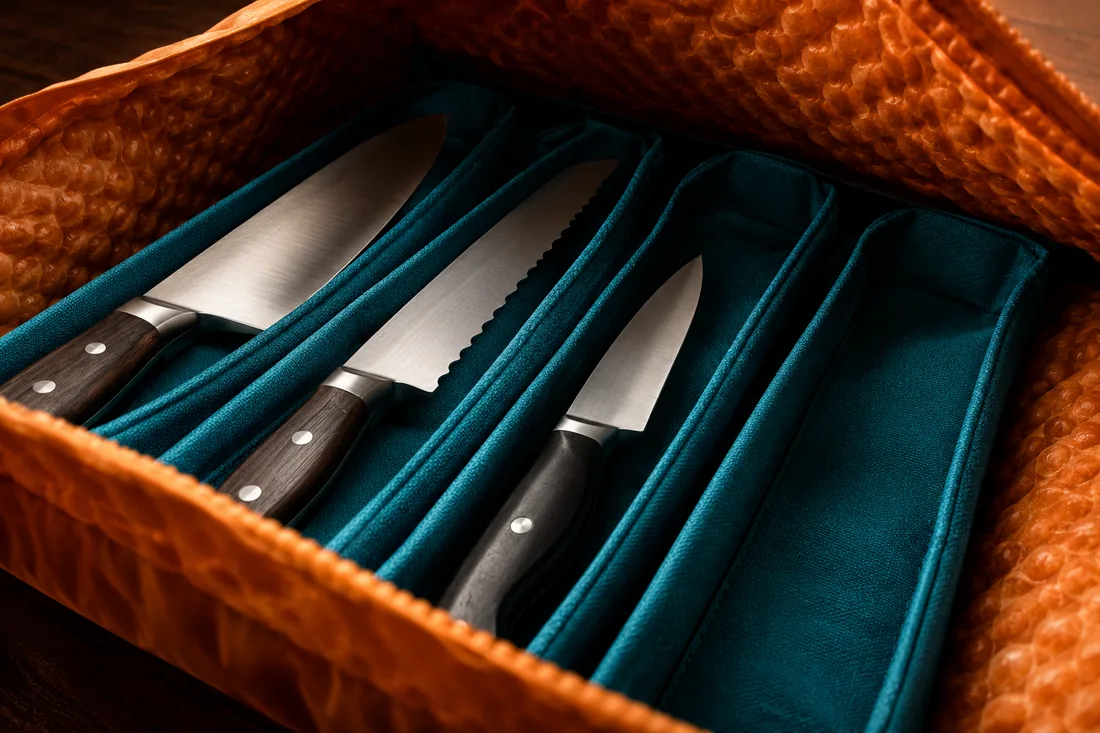



Check whether the reader understands what comes with the mailer.
FAB: make the benefit follow from the feature
Give someone the draft, supplied instructions and empty mailer. Ask what they would need to prepare before packing. If they think they must make blade covers, find the passage that left the supplied sleeves unexplained.
These are teaching images made for the lesson, not documentary evidence.
Use features versus benefits when that connection feels stretched. Ask what the sleeve actually enables. If the answer becomes "complete peace of mind," return to the packing step and show someone how it works.
If someone starts looking for cardboard despite the supplied sleeves, revise the explanation and try it again. Keep that observed misunderstanding beside the draft so the next writer knows why you named the sleeves.
Test two structures against one decision
Use the editing passes to compare the completed AIDA and four-P drafts above. Both cover the same demonstration, acceptance check, price and mailing process. AIDA puts the process before the evidence; the four-P version puts the result and proof before the process.
Give both drafts to someone with Auden's questions about acceptance and sharpening. Ask which answer they look for first, then have them find it and explain what happens next. Repair missing information in both versions before comparing their order.
Auden's question decides the order
I know what a blunt knife does. Show me the sharpened blade.
Auden, invented reader response for this exercise
In this imagined read-through, Auden skips AIDA's kitchen scene and mailer paragraph to reach the comparison. Use the four-P order for this version: it brings the result and its evidence forward, answering the question he wants settled before considering the mailing commitment.
Auden opens the comparison, checks the blade type and then reads the proposal to find out whether his knife qualifies. If he had wanted the mailing explanation first, AIDA's earlier process paragraph would give you a useful starting order instead.
Read next

Lesson 1 of 6 in Frameworks
Sources & further reading
- Every Copywriting Formula Ever (or The Ultimate Guide to No-Pain Copywriting)
- 18 Copywriting Formulas (Plus Examples of Each)
- The Psychology of Salesmanship