Write native ads from evidence, not invented mechanisms
A strong native ad connects an observed customer situation to a claim you can actually support.
- native advertising
- copywriting
- customer research
In five minutes
Build an evidence-bounded brief that separates audience signals, product proof, and the story you choose to tell.
You open an ad library and find a familiar pattern: a competitor has run variations of the same promise for months. The language is specific. The comments look active. The creative seems to point to an audience you have not considered.
It is tempting to treat that sequence as a shortcut. Pick a neighbouring audience, give their problem a more elaborate explanation, and write a story that makes the product feel inevitable.
The risk is not that the copy sounds weak. The risk is that it sounds more certain than the evidence allows.
Call this the borrowed explanation: taking a market signal, adding a persuasive cause, and quietly treating the finished story as proof. It is one of the fastest ways for native advertising to become both less trustworthy and harder to improve.
A clearer explanation is not automatically a truer explanation.
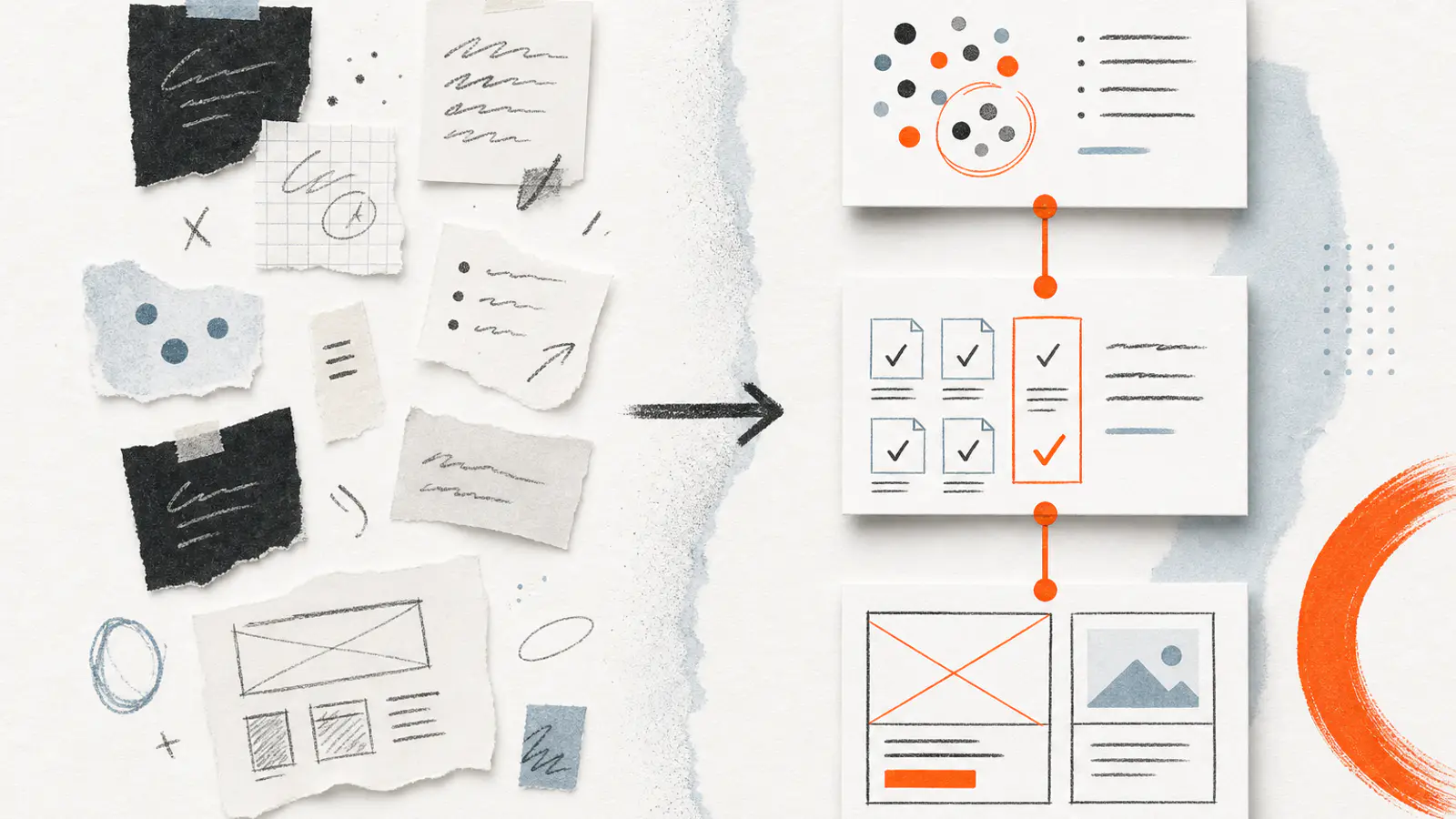
The useful alternative is not bland copy. It is an evidence chain: a visible path from a real situation, through a supportable claim, to an original argument that a reader can understand without being misled.
- Observed situation
- Audience signal
- Claim you can support
- Original ad argument
- Pre-launch claim check
Start with a situation, not a demographic
“Women over 40” or “new founders” may be helpful media-buying labels. They are not yet a reason to write a particular ad. A useful audience description begins with something that changed: a new constraint, repeated frustration, failed attempt, or decision that now carries more weight.
An ad library can help you notice a possible situation. It cannot prove that the situation is common, that a gap is truly open, or that your product solves it better than another option.
Keep those distinctions explicit.
| What you observed | What it may support | What it does not support |
|---|---|---|
| A competitor repeats one angle | The angle may attract attention in that market | The competitor's explanation is true |
| Several people name the same frustration | The situation is worth further research | Every person shares the same cause or need |
| A product feature maps to the frustration | A testable product hypothesis | A guaranteed outcome |
The aim is not to discover an exotic sub-group that no one else has named. It is to find a lived situation where the language, previous attempts, and next decision are meaningfully different from the broad message already in market.
For example, “people who want better skin” is a category. “People who have tried three surface-level fixes and still cannot explain what they are deciding between” is the beginning of a research question. The second version tells you what to investigate before it tells you what to promise.
Build a signal map before you build the story
Native ads often feel personal because they use concrete details. That does not license inventing a person, a diagnosis, or a turning point. Specificity should come from a traceable research record.
Create a short signal map for one candidate audience:
- Record the recurring moment. What happens immediately before the person starts looking for a solution? Keep the wording close to the source or label it as a paraphrase.
- List prior attempts. What did they try, what did they expect, and why did they stop? A failed attempt is not proof of product failure; it is context for the next question.
- Separate desire from diagnosis. “I want to feel comfortable wearing this again” is an observed desire. “My problem is caused by X” is a claim that needs its own evidence.
- Mark the source of every important detail. Customer interview, support record, public discussion, product documentation, or a clearly labelled hypothesis are not interchangeable.
This makes the work slower in the first hour and faster later. When a draft begins to drift, you can see exactly which sentence belongs to a real signal and which one was added only because it made the narrative smoother.
The job is not to make a prospect recognisable enough to target. It is to understand the decision they are already trying to make.
Treat the mechanism as an evidence boundary
Many ads use a mechanism to connect a problem with a product: why the problem persists, why earlier attempts failed, and why this solution is different. That structure can be useful. It can also turn a plausible story into a medical, scientific, or performance claim by accident.
Classify the sentence before you put it into the ad.
| Evidence level | Safe use in a draft |
|---|---|
| Observed pattern | Describe what people repeatedly report or experience, with context |
| Working hypothesis | Frame it as a question or an idea to verify, not a conclusion |
| Verified product function | State only what product documentation and credible evidence support |
This is especially important when a product touches health, appearance, finances, or other high-stakes choices. A metaphor can make a claim easy to picture without making it true. An AI-generated explanation can connect the steps of an argument without adding a single source to support them.
Before using a mechanism, ask:
- What source supports the cause I am naming?
- What source supports the product's exact function?
- Am I describing an observation, a hypothesis, or a verified fact?
- Would a reasonable reader understand the limitation I am leaving out?
If the answer is unclear, keep the audience insight and remove the causal claim. A narrower argument that remains true is more durable than an elegant explanation you cannot defend.
Use native structure without borrowing someone else's certainty
The useful part of a strong reference ad is usually its sequence, not its exact story. You can study where it earns attention, where it answers an objection, and how it changes pace before asking for action.
A simple original structure can be enough:
- Recognition: begin with a real, researched moment rather than a generic benefit.
- Tension: name the choice or frustration that makes the moment matter.
- Evidence: explain only the part of the situation and product you can support.
- Practical next step: show what the reader can inspect, compare, or try without pretending certainty.
- Clear action: invite a next step that matches the evidence, offer, and landing page.
This retains the rhythm of native advertising without copying an expert reveal, a testimonial arc, or a competitor's unsupported mechanism. The story belongs to your research, not to the reference that suggested a pacing pattern.
Run the claim check before launch
Before an ad goes live, read every sentence that implies cause, proof, difference, or result. Then run a quick three-column check.
## Sentence

What exactly would the reader infer?

## Support

Which source, product record, or clearly labelled limitation supports it?

## Revision

Keep, qualify, replace with an observation, or remove.
The check is deliberately unglamorous. It catches the moment when “customers mention this” becomes “this causes that,” or when one product feature becomes “the only answer.” It also improves creative decisions: you learn which claims need research, which need a different offer, and which should never have entered the draft.
The next time an ad library seems to hand you a perfect angle, pause before writing the mechanism. What has actually been observed? What remains a hypothesis? And what could you say that would still be useful if the most persuasive sentence disappeared?
Source notes
Material behind this lesson
Continue the thread
Keep the question open.
Browse the library when another question becomes useful, or return when the next lesson is ready.